When making decisions:
Consider both explicit AND implicit cost
One of the main differences between Economics and Accounting
We have to compute marginal benefit (MB) and marginal cost (MC)
Marginal benefit: Additional benefit when making the deicision
Marginal cost: Additional cost paid to make the decision
Ignore past cost (sunk cost)
Ex: When deciding whether or not to continue working on a project, ignore the past cost for getting to this point when calculating the benefit and cost
Classwork
a.
Marginal benefit: 800</font>
Marginal cost: <font color="#ffc000">600
worth it
Sunk cost: $1000
b.
Marginal benefit: 500</font>
Marginal cost:<font color="#ffc000"> 600
not worth it
Sunk cost: $1000
## Scarcity / Limited Resources:
Absolute
Can not be increased
Ex: Time
Relative
Relative to location or demand
Ex: Oil/Gas/Food
Economics vs. Islamic Economics
Economics:
focuses on efficiency only (maximizing profit and minimizing loss).
Islamic Economics:
-Does the same as former, but also valuing fairness and equality.
-If they were to be applied, many world problems like world hunger and climate change would be greatly reduced if not completely fixed.
-Benefits both the rich and the poor.
-Scarcity is relative. Context I found about this on Google 🔽

PPF
Production Possiblities Frontier (PPF)
| Good 1 | Good 2 | |||
|---|---|---|---|---|
| A | 0 | 0 | 4 | 20 |
| B | 1 | 4 | 3 | 18 |
| C | 2 | 7 | 2 | 14 |
| D | 3 | 9 | 1 | 8 |
| E | 4 | 10 | 0 | 0 |
| Time is absolute (can’t be changed), and goods are relative. |
Q: What’s the opportunity cost of producting one more unit of good 1 if the third hour is added? (as in we’re at the second hour and we add to the third)
*The opportunity cost of producing 1 unit more = loss / gain
2/6= 3 units
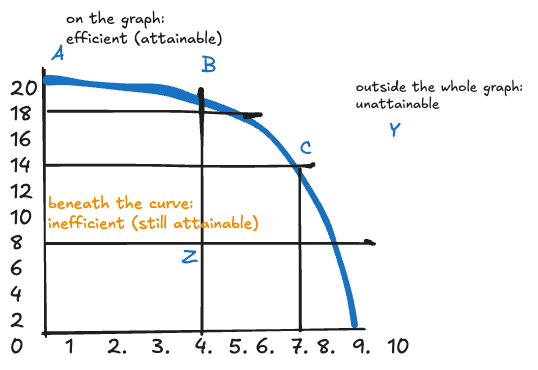
Efficient points: on the curve itself (A, B, C)
Inefficient points: beneath the curve (D)
Attainable points: Efficient points + Inefficient points
Unattainable points: outside of what the PPF curve covers (E)
note: Y and Z are hypothetical points for demonstration purposes only; they don’t actually exist in the real graph.