Elasticity of Demand
Income Elasticity of Demand (IED)
measures how much the quantity demanded for a good changes in response to a change in consumer income
IED = %change in quantity demanded / %change in income
Ex: Starbucks estimates IED for coffee to be 2.6, how will increase in consumers’ income by 6 percent impact the quantity of coffee selling?
2.6 = 6 / x = 15.6%
Criteria for deciding whether the relationship is Complementary, Subsitution, or none
If price goes up and demand goes down then complement
If the price and demand goes up together then it’s subsitute
If the two are unrelated, then it’s **none.
Price Elasticity of Demand (PED)
Division by Start Value:
% change in Quantity Demanded = end - start / start * 100 = 33%
% changed in Revenue = End - start / start * 100 = 250 - 200 / 200 * 100 = 25%
33 / 25 = 1.32
Division by Midpoint Value:
Q Midpoint: 12 + 8 / 2 = 10
Q: 12 - 8 / 10 * 100 = 40%
E Midpoint: 200 + 250 / 2 = 225
E: 250 - 200 / 225 * = 22%
22 / 40 = 1.8
Price midpoint: 90 + 70 / 2 = $80
Quantity demanded midpoint: 5000 + 3000 / 2 = 4000
P: 90 - 70 / 80 = 25%
Qd: 3000 - 5000 / 4000 = -0.5 = 50%
Price Elasticity of Demand: 25/50 = 0.5
Two Extreme Cases
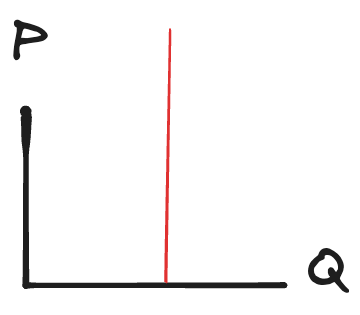
Perfectly Inelastic Demand
Quantity demanded is constant no matter what the price is (Ex: pain killers, insulin (crucial products that cannot be replaced))
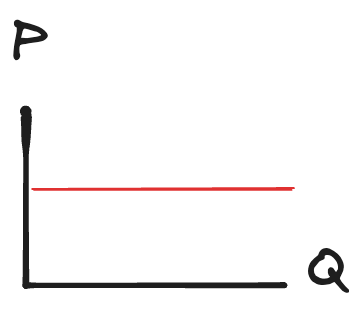
Perfectly Elastic Demand
Example: something luxurious that can easily be replaced if the price is unsatisfactory.