study equibilirium + shortage + surplus (took place in Sunday and I was sick)
Equilibrium: the middle point where quantity demanded equals the supply
shortage: when the supply is less than the demand
surplus: when the supply is more than the demand
Budget Line
Showing the maximum that can be consumed
Affordable: within the curve
Unafforable: beyond the curve
Income Equation: Pa . Qa + Pb . Qb
Related exam questions:
-Explain the main idea of budget lines
-Calculate the slope of the budget line
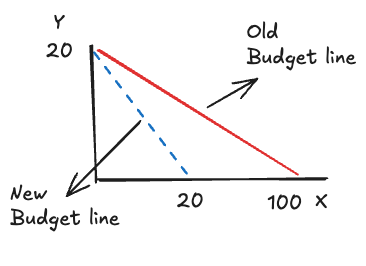
A consumer has initial income of 1 and Py = 5.
First part of the question:
Income = Px . Qx + Py . Qy
100 = 0 + 5 * Qy
100 = 5 * Qy
Qy = 20 Units
Qx = 1 * Qx
Qx = 100 Units
Second part:
100 = 5 Qx —> Qx = 100/5 = 20 Units
Law of Diminishing Marginal Utility (Utility = Satisfaction)
New Chapter:
| Q | P | Tc | TR = P*Q | Profit (TR - Tc) |
|---|---|---|---|---|
| 0 | 10 | 5 | 0 | -5 |
| 1 | 10 | 9 | 10 | 1 |
| 2 | 10 | 15 | 20 | 5 |
| 3 | 10 | 23 | 30 | 7 |
| 4 | 10 | 33 | 40 | 7 |
| 5 | 10 | 45 | 50 | 5 |
Profit Maximization Rule
MR (Marginal Revenue) = MC (Marginal Cost)
MC = Change in TC / change in Q
MR = Change in TR / Change in Q
Calculating The Average
Average Fixed Cost: Fixed Cost / Q
Average Variable Cost: Variable Cost / Q
Average Total Cost: Tc / Q
Total Cost (Tc)
Fixed Cost: Costs that do not change with quantity
Variable Cost: Costs that change with quantity
If Fixed Cost = 0 —> we’re in the long run
otherwise short run
\
Graphs Expected in Exam:
Equilibrium / Shortage / Surplus
Budget Line
Total Utility
Consumer Surplus / Total Surplus / Producer Surplus